


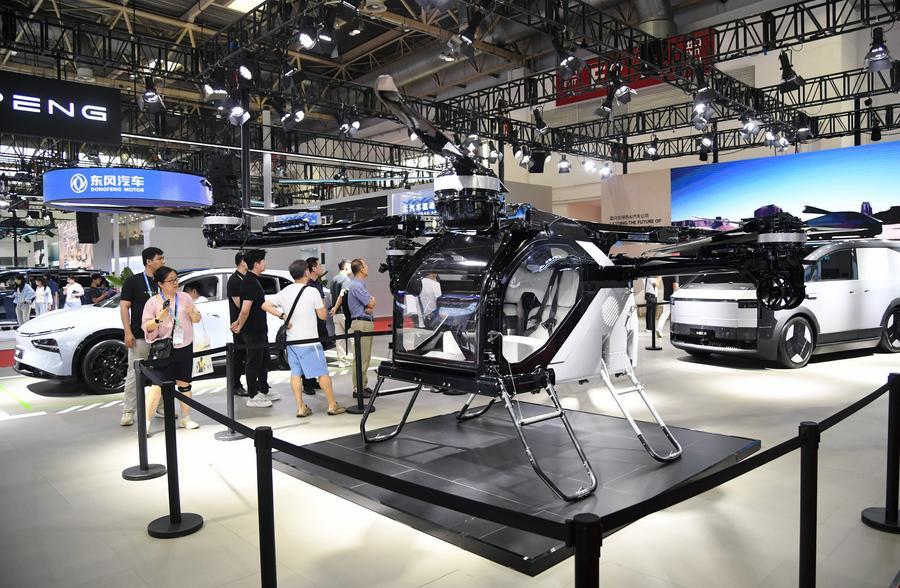
BEIJING, Aug. 12 (Xinhua) -- During last month's third China International Supply Chain Expo (CISCE), overseas exhibitors made up 35 percent of participants -- up 3 percentage points from 2024 and 9 points from the inaugural 2023 edition -- with industry giants like Honeywell, GE Healthcare, and Siemens already securing their spots for next year, underscoring foreign firms' growing commitment to China.
As a major national platform for global industrial collaboration, the CISCE embodies the enduring appeal of the Chinese market during its 14th Five-Year Plan period (2021-2025), marked not only by increased foreign investment but also by significant shifts in investment fields that reflect China's broader economic transformation.
HARD-WON GAINS
The expo's momentum echoes wider trends. By June 2025, China's actual utilized foreign direct investment (FDI) reached 708.73 billion U.S. dollars since 2021, hitting the 14th Five-Year Plan target of 700 billion U.S. dollars six months ahead of schedule.
In the same period, 229,000 new foreign-invested enterprises were launched, 25,000 more than in the 2016-2020 period.
Despite fluctuations in FDI in recent years, China's ability to maintain steady foreign capital inflows stands out in a challenging global environment.
According to the United Nations, global FDI fell 11 percent in 2024, marking the second straight year of decline after a sharp drop in 2023. Early data for the first quarter of 2025 offers little optimism, suggesting a possible third consecutive year of contraction.
"Weak global direct investment has weighed on China's FDI, but a closer look shows resilience," said Fan Penghui, a senior researcher with the Chinese Academy of International Trade and Economic Cooperation, a think tank with the Ministry of Commerce. "A periodic slowdown after a peak is normal. Investment cycles ebb and flow."
FOCUS ON HIGH-TECH SECTORS
In fact, China's high-tech industries and service sectors have seen continuous growth in foreign investment, which underscores that foreign capital is riding on the development wave of China's new quality productive forces, Fan noted.
In 2024, high-tech industries attracted 34.6 percent of foreign investment, up 6 percentage points from 2020. The first half of 2025 accelerated this shift. High-tech sectors attracted 127.87 billion yuan in foreign capital, with e-commerce services surging 127.1 percent, chemical pharmaceuticals up 53 percent, and aerospace equipment manufacturing rising 36.2 percent.
Amid China's artificial intelligence (AI) boom and computing capacity boost, U.S. materials science giant Corning plans to localize the production of high-end optical fibers in Shanghai, responding to the need for denser, faster data transmission in AI data centers, where fiber requirements are much higher than those in traditional facilities, according to Lin Chunmei, president and general manager of Corning Greater China.
For many multinational corporations, China has evolved beyond a sales market into a hub for growth and innovation, prompting increased R&D investment to tap into the country's innovation potential.
According to Leng Yan, executive vice president of Mercedes-Benz China, the company has poured over 10.5 billion yuan into Chinese R&D over five years, and with its Shanghai R&D center, the company's local innovation now "leads global development."
HOLD IT STEADY
China's success in attracting foreign investment is underpinned by a deliberate policy push to keep foreign investment steady, including opening more fields to foreign firms and creating a more welcoming environment.
The negative list for foreign investment has been steadily shortened, with all manufacturing restrictions eliminated in 2024. Pilot programs are also opening up services like value-added telecom and biotechnology.
To build trust and cut red tape, a roundtable consultation system for foreign businesses was established. Since 2023, the Ministry of Commerce has held over 30 meetings, resolving more than 1,500 operational issues raised by foreign firms.
Plans are in motion to expand these efforts. A revised catalogue of industries encouraged for foreign investment is in the works. The updated list will guide more foreign capital toward advanced manufacturing, modern services, high-tech, energy conservation, and environmental protection sectors, as well as into central, western and northeastern regions, according to the country's top economic planner.
"As China continues to expand institutional opening up, foreign investment is expected to integrate more deeply into domestic innovation and supply chains, striking a new balance with growing emphasis on quality," Fan said.

 首頁
首頁

 陜公網安備 61010302000964號
