


By Luke Johnston
Walking throughUrumqi's Grand Bazaar, a vendor lifted a samsa from the tandoor and pressed it into my hands, flaky, peppery, uncannily close to a Cornish pasty. He began in a volley of Uyghur, then grinned and switched to English, "Hey bro, where are you from?" For a heartbeat I wondered if I had stumbled back to the UK; alas, I was in China's far northwest, Xinjiang.
Often, when I stepped into a shop, the keeper would greet me in Uyghur, assuming I was local. I hesitated, they laughed and shifted to Mandarin, telling me I looked like a cousin until a second glance gave me away.
I drifted past foods I had never seen despite travelling widely in China, past stalls hung with Turkish style brass lamps straight out of a storybook, past mosques that you would see every 5 minutes down the road. I was in China, yet the streets felt totally new to me, familiar and distant at once.
Talking with them, I thought, for the first time, perhaps this could be my home.
I chose Xinjiang at a crossroads. With a PhD in Statistics, I had offers across China and even one in the UK with a top AI company on a generous salary. Xinjiang felt like a place leaning into the AI future, and I hope to move into that field soon.
For now, I teach statistics and English at an international school. The work keeps me close to language and logic and leaves weekends free to roam a region roughly seven times the size of the UK. Xinjiang has not only history and desert, it looks steadily toward the future. Teaching here lets me live well, learn steadily, and explore widely.
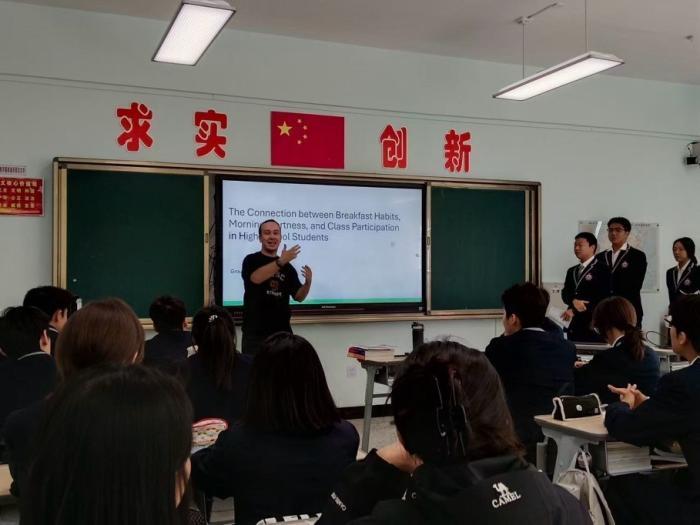
Luke Johnston teaches a Statistics class at an international school in Xinjiang. (Photo provided by the author)
After I moved to Xinjiang, I discovered how far a teacher's salary can go. By teacher standards, I genuinely live like a king, a 120 square metre apartment for about 2,000 Yuan (about 280 dollars) a month, and taxis across town for 10 yuan (about 1.4 dollars), delicious everyday meals for around 15 Yuan (about 2 dollars).
The result is simple, life is comfortable, the basics are affordable, and I can save a great deal while focusing on what brought me here: life here truly feels blissful.
A long week can end with simple pleasures, I often go horse riding in the foothills, skiing in winter, and hiking through the summer grasslands. What a life!
I've been able to travel all around this gigantic land now too. In Tacheng I have tasted Kazakh horse meat. In Tashkurgan I caught a shard of Tajik culture against a backdrop of glaciers. The borders of Central Asia feel close enough to touch. Once, for about 22 dollars, I took a bus from Xinjiang to the city of Almaty in Kazakhstan which only took a few hours and spent a weekend where the street signs changed script but the food tasted familiar. Xinjiang borders eight different countries, so there's so much to explore and see here, you really are on the silk road!
Inside the school, the pace is human. My classes have around 10 to 20 students, which means there is time to hear every voice. With smaller groups I can give feedback that actually lands and watch confidence arrive in real time.
Many of my students come from minority backgrounds, Uyghur, Kazakh, and others.
I have great relationships with many of them, often playing football on Thursdays. I have been invited to their homes for tea, where they have introduced local festivals, Nowruz for Kazakhs and Eid for Muslim Uyghurs. I love that the calendar here is rich with local celebrations, and there is ample time to enjoy them.

Luke Johnston plays football with some students at an international school in Xinjiang. (Photo provided by the author)
Of course there are adjustments.Language here is layered, that is part of the fun and the challenge. Most translation apps still struggle with Uyghur's twists, and I have had my share of comic misfires.
The climate is a tough ask too. Winters can drop to minus 30 degrees Celsius. I have learned the physics of black ice the hard way, slipping over several times to the amusement of passers by. The air is dry enough to turn a page into sandpaper, I keep moisturiser and a humidifier as standard equipment.
But there are plenty of positives and surprises. Strangers will often stop me on the street for a photo. I am certainly not famous, I have around 75,000 fans on one Chinese app, but since I am one of the few Europeans living here, many recognise me and appreciate that I learn their culture. That is the key-- people may seem distant at first, but if you show respect, learn a little language, and even try local clothes, doors open. It is an easy way to make friends.
I added that vendor on WeChat and greet him whenever I walk past, yes, the man who once mistook me for a local now knows me by my flawed "yakshimusiz." That is life here in one exchange, welcoming, practical, and easier than you would expect, a place where it is simple to arrive as a foreigner because so many people are ready to help you become a neighbour.
The author is a PhD candidate in AI at Shanghai Jiao Tong University. The views do not necessarily reflect those of ECNS.

 首頁
首頁

 陜公網安備 61010302000964號
