


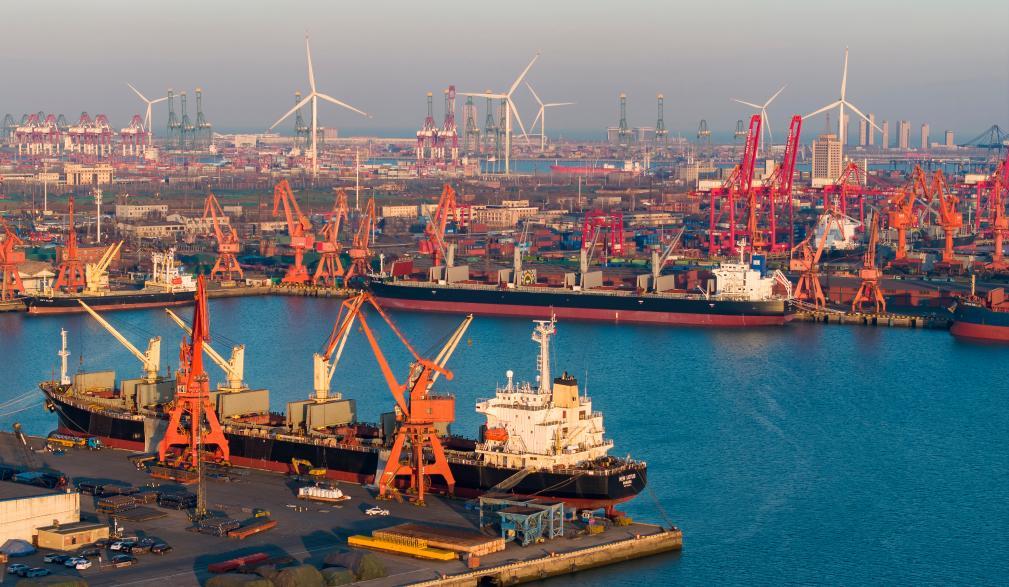
A drone photo taken on Jan. 2, 2026 shows a view of a terminal of a subsidiary of Tianjin Port Holdings Co., Ltd. at Tianjin Port in north China's Tianjin. (Xinhua/Zhao Zishuo)
BEIJING, Jan. 19 (Xinhua) -- For years, China's economy has confounded the pessimists. While skeptics have routinely scrutinized every new challenge or external shock as a prelude to inevitable decline, facts on the ground speak for themselves: While not immune to headwinds, the Chinese economy has proved far more resilient than many expected.
Latest official data reinforce the assessment. Despite external shocks and domestic challenges, the Chinese economy expanded by 5 percent in 2025, a pace that met the set target and remained robust by global standards.
A closer look at the data reveals the resilience of China's economy, with solid momentum in equipment and high-tech manufacturing, steady expansion in modern services, and continued optimization of the trade structure.
China, notably, managed to secure such gains amid an extremely volatile trade environment, a structural property-sector correction, and lingering domestic imbalances between supply and demand.
By leveraging timely policy adjustments, trade diversification, and an economy large enough to absorb shocks, China navigated a challenging year without sharp dislocations many analysts had predicted.
The pillars that underpinned China's growth over the past decades remain firmly in place. A domestic market of 1.4 billion consumers continues to anchor consumption, while China's extensive, flexible supply chains ensure manufacturing continuity.
Stability is further reinforced by consistent policy design. Long-term five-year planning, along with targeted fiscal and monetary measures and a dedication to structural reforms, provides predictability for both markets and investors.
As pressures mount on traditional growth drivers, a new vanguard of forces has come to the fore, with innovation now central to China's growth momentum. New energy vehicles, photovoltaics, robotics and artificial intelligence are fueling a transition from quantity-driven expansion to quality-led growth. This technological leap is paralleled by a rapid green transition in the country, where renewable capacity is expanding at a world-leading pace.
Beyond policy and scale, China's most subtle yet formidable asset lies in its people -- from diligent workers on the factory floor to brilliant minds in research labs. Their collective ingenuity and grit form the solid bedrock of the economy and will serve as a perpetual engine for the country's future growth.
This strength aligns precisely with the country's dual strategy of investing in both physical infrastructure and human capital for the 15th Five-Year Plan period (2026-2030). By recognizing that investing in education and skills development is as vital as building smart factories, China is effectively upgrading its "human engine" to drive its future trajectory.
Furthermore, China's commitment to openness amplifies these internal strengths. Policy reforms, global partnerships through trade agreements, and measures to attract and protect foreign investment have created a more predictable business environment, integrating China into the world economy while reinforcing a stable growth trajectory at home.
That said, a sound understanding of the Chinese economy requires more than just affirming its strengths. It also demands an objective assessment of both entrenched structural issues and emerging headwinds. As highlighted by the Central Economic Work Conference, China continues to face a complex landscape where external pressures are intensifying and domestic imbalances, particularly the friction between robust supply and lackluster demand, remain pronounced.
However, these are fundamentally the growing pains of a structural transition. By leveraging the core advantages provided by its governance system, ultra-large economic scale, comprehensive industrial chain and vast reservoir of talent resources, China is well-positioned to deal with these risks, just as it has weathered numerous challenges before.
In an uncertain global landscape, China's strength may lie less in how fast it grows, and more in how steadily, and how sustainably, it keeps moving forward. ■
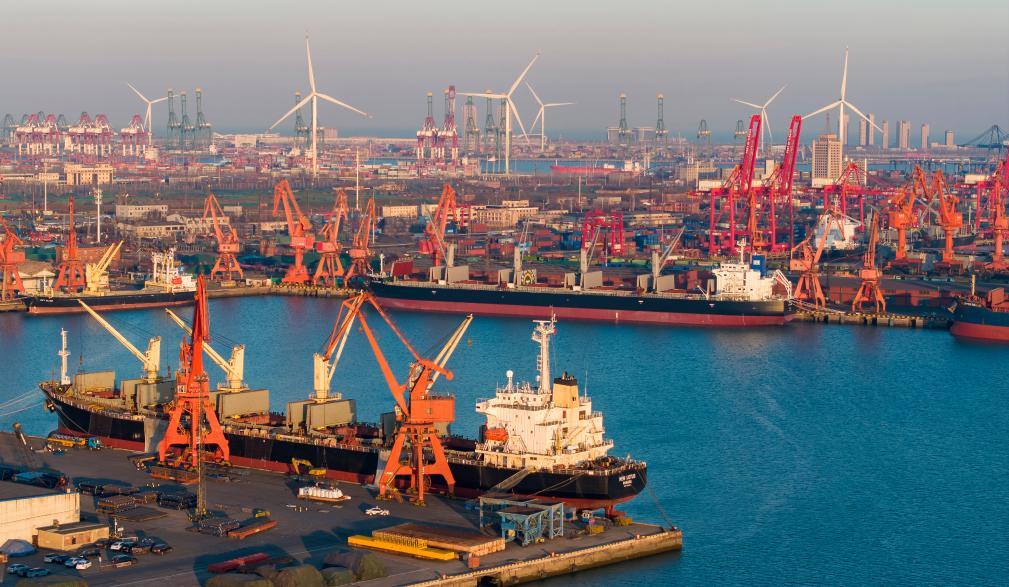
A drone photo taken on Jan. 2, 2026 shows a view of a terminal of a subsidiary of Tianjin Port Holdings Co., Ltd. at Tianjin Port in north China's Tianjin. (Xinhua/Zhao Zishuo)
BEIJING, Jan. 19 (Xinhua) -- For years, China's economy has confounded the pessimists. While skeptics have routinely scrutinized every new challenge or external shock as a prelude to inevitable decline, facts on the ground speak for themselves: While not immune to headwinds, the Chinese economy has proved far more resilient than many expected.
Latest official data reinforce the assessment. Despite external shocks and domestic challenges, the Chinese economy expanded by 5 percent in 2025, a pace that met the set target and remained robust by global standards.
A closer look at the data reveals the resilience of China's economy, with solid momentum in equipment and high-tech manufacturing, steady expansion in modern services, and continued optimization of the trade structure.
China, notably, managed to secure such gains amid an extremely volatile trade environment, a structural property-sector correction, and lingering domestic imbalances between supply and demand.
By leveraging timely policy adjustments, trade diversification, and an economy large enough to absorb shocks, China navigated a challenging year without sharp dislocations many analysts had predicted.
The pillars that underpinned China's growth over the past decades remain firmly in place. A domestic market of 1.4 billion consumers continues to anchor consumption, while China's extensive, flexible supply chains ensure manufacturing continuity.
Stability is further reinforced by consistent policy design. Long-term five-year planning, along with targeted fiscal and monetary measures and a dedication to structural reforms, provides predictability for both markets and investors.
As pressures mount on traditional growth drivers, a new vanguard of forces has come to the fore, with innovation now central to China's growth momentum. New energy vehicles, photovoltaics, robotics and artificial intelligence are fueling a transition from quantity-driven expansion to quality-led growth. This technological leap is paralleled by a rapid green transition in the country, where renewable capacity is expanding at a world-leading pace.
Beyond policy and scale, China's most subtle yet formidable asset lies in its people -- from diligent workers on the factory floor to brilliant minds in research labs. Their collective ingenuity and grit form the solid bedrock of the economy and will serve as a perpetual engine for the country's future growth.
This strength aligns precisely with the country's dual strategy of investing in both physical infrastructure and human capital for the 15th Five-Year Plan period (2026-2030). By recognizing that investing in education and skills development is as vital as building smart factories, China is effectively upgrading its "human engine" to drive its future trajectory.
Furthermore, China's commitment to openness amplifies these internal strengths. Policy reforms, global partnerships through trade agreements, and measures to attract and protect foreign investment have created a more predictable business environment, integrating China into the world economy while reinforcing a stable growth trajectory at home.
That said, a sound understanding of the Chinese economy requires more than just affirming its strengths. It also demands an objective assessment of both entrenched structural issues and emerging headwinds. As highlighted by the Central Economic Work Conference, China continues to face a complex landscape where external pressures are intensifying and domestic imbalances, particularly the friction between robust supply and lackluster demand, remain pronounced.
However, these are fundamentally the growing pains of a structural transition. By leveraging the core advantages provided by its governance system, ultra-large economic scale, comprehensive industrial chain and vast reservoir of talent resources, China is well-positioned to deal with these risks, just as it has weathered numerous challenges before.
In an uncertain global landscape, China's strength may lie less in how fast it grows, and more in how steadily, and how sustainably, it keeps moving forward. ■

 首頁
首頁


 陜公網安備 61010302000964號
